




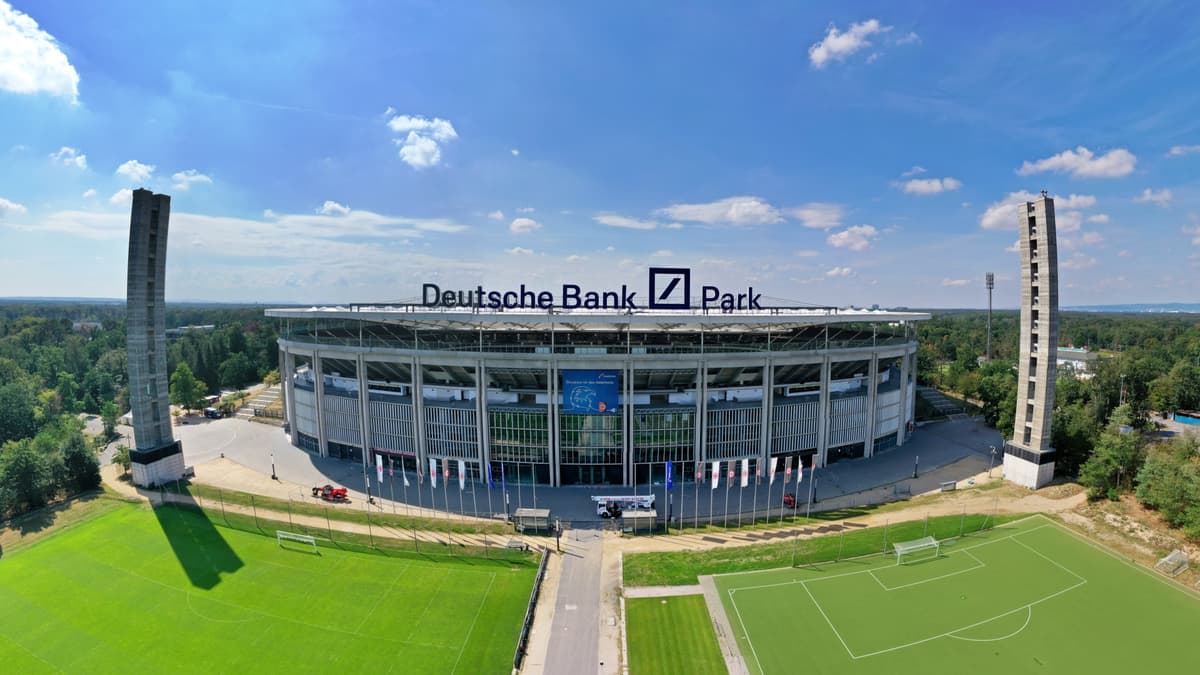
 View photos
Deutsche Bank Park Seating Map
Your seating plan and chart: where to sit, the best seats and the view from your seat
“Waldstadion” · “Der Waldstadion”
Deutsche Bank Park in photos
5 outside · 2 inside the venue
Where to sit at Deutsche Bank Park
The best seats at Deutsche Bank Park are Haupttribüne, central upper for the view. For value, choose Gegengerade. For atmosphere, head to Nordwestkurve. Avoid Back rows of the upper tiers. Deutsche Bank Park seats 58,000, home of Eintracht Frankfurt.
Haupttribüne, central upper
On the halfway line, covered and elevated for the clearest read of the game.
Full detail Best valueGegengerade
A central side view for less than the main stand.
Full detail Best atmosphereNordwestkurve
Eintracht’s ultras’ terrace, famous across Europe for its noise and choreography.
Full detail Where to avoidBack rows of the upper tiers
The highest seats sit well back from the far goal in a big bowl.
Full detailAbout Deutsche Bank Park
Deutsche Bank Park, still affectionately called the Waldstadion, holds around 58,000 for Bundesliga matches and is home to Eintracht Frankfurt, whose European nights are famous for their noise and colour. The Nordwestkurve behind one goal is the ultras’ terrace and the beating heart of the support, with the Haupttribüne (main stand) on the west side and the Gegengerade opposite. Standing areas convert to seats for international games, lowering capacity. The forest setting, membrane roof and glowing video cube give it a distinctive feel, and central Haupttribüne seats offer the best all-round view.
Set in Frankfurt’s Stadtwald forest, the original Waldstadion dates to 1925 but was completely rebuilt for the 2006 World Cup, giving it a translucent membrane roof and a striking central video cube suspended over the pitch. A retractable inner roof can close the centre in bad weather, and the tight rebuild brought fans close to the action.
Seating plan & map
This is the map used for ticket sales at Deutsche Bank Park. Exact configuration varies by event.
How the venue is set up
Bundesliga / domestic football
Around 58,000 including standing, with the Nordwestkurve as the ultras’ terrace and away fans in a segregated corner.
European / international matches
Terraces convert to all-seater, cutting capacity to roughly 48,000–51,000 with a designated visiting-fan section.
Concerts / NFL / other events
The stadium hosts major concerts and has staged American football; the retractable centre roof helps for events, and the pitch turns to standing floor for shows.
Seating levels explained
HaupttribüneOber-/Unterrang West
The main grandstand with the halfway line, dugouts, tunnel and premium and press areas.
Pros: Best central sightlines and cover from the roof.
Cons: The most expensive tier.
GegengeradeOber-/Unterrang Ost
The side stand opposite the main stand.
Pros: Central side view for less than the Haupttribüne.
Cons: Faces the dugouts rather than housing them.
NordwestkurveNordwestkurve
The home ultras’ terrace behind the goal, the loudest part of the ground.
Pros: The atmosphere, flags and songs — Eintracht’s heart.
Cons: Standing for domestic games and a behind-goal angle.
SüdkurveSüdkurve
The opposite end, home support with the away allocation in a corner.
Pros: Cheaper behind-goal seats and terracing.
Cons: Behind-goal sightline and proximity to visiting fans.
Best seats at Deutsche Bank Park
Best overall view
Haupttribüne, central upper
On the halfway line, covered and elevated for the clearest read of the game.
Best value
Gegengerade
A central side view for less than the main stand.
Best atmosphere
Nordwestkurve
Eintracht’s ultras’ terrace, famous across Europe for its noise and choreography.
With kids / calm
Upper Gegengerade
Seated, full-pitch view away from the standing kurve.
Neutral / photographer
Upper Haupttribüne
High central angle capturing the whole pitch and the kurve displays.
| For | Sections | Why |
|---|---|---|
| Best overall view | Haupttribüne, central upper | On the halfway line, covered and elevated for the clearest read of the game. |
| Best value | Gegengerade | A central side view for less than the main stand. |
| Best atmosphere | Nordwestkurve | Eintracht’s ultras’ terrace, famous across Europe for its noise and choreography. |
| With kids / calm | Upper Gegengerade | Seated, full-pitch view away from the standing kurve. |
| Neutral / photographer | Upper Haupttribüne | High central angle capturing the whole pitch and the kurve displays. |
Seats to avoid & obstructed views
Back rows of the upper tiers: The highest seats sit well back from the far goal in a big bowl.
Front of the lower behind-goal blocks: Low angle behind the net makes far-end play hard to follow.
Corners by the away segregation: Buffer zones and a flatter atmosphere on the visiting-fan boundary.
Some lower rows under the roof edge: Wind-driven rain can still reach seats near the open front of the canopy.
Accessibility & companion seating
The rebuilt stadium provides wheelchair and companion positions with step-free access, lifts and accessible facilities, bookable in advance through Eintracht Frankfurt’s ticket service. Accessible parking and assistance are available on request.
Where: Wheelchair spaces are placed around the lower tier including central and behind-goal locations.
Food & drink at Deutsche Bank Park
The concourse kiosks cover the Bundesliga staples — Bratwurst, pretzels and beer from modern tap systems — alongside dedicated burger kiosks and a distinctly Hessian twist: the Hessenburger, made with pulled Kassler and Handkäs. Frankfurt's local apple wine, Äppelwoi, is sold at numerous stands, and the 22 modernised kiosks carry screens so you can follow the match while queueing.
Kiosks take mainpay contactless payment via smartphone or watch as well as cards, and away-section kiosks also accept cash, Google Pay and Apple Pay. Outside food and drink are banned under the stadium rules, except non-alcoholic drinks in cartons of up to 500 ml.
Worth seeking out
- Hessenburger with pulled Kassler and Handkäs at burger kiosks
- Stadium Bratwurst and pretzels at concourse kiosks
- Frankfurt Äppelwoi (apple wine) at numerous stands
- 22 modernised kiosks with pitch-view screens
Hotels near Deutsche Bank Park
All hotels & live prices 5-star
Kennedy 89 In The Unbound Collection By Hyatt
Frankfurt
See live prices 4-star
Crowne Plaza Frankfurt Congress Hotel by IHG
Frankfurt
See live pricesStays close to Deutsche Bank Park, with availability checked when we built this guide. Tap a hotel for live prices on your dates.
Getting there
Transport
Tram lines 20 and 21 run to the Stadion stop right outside, and matchday S-Bahn services (S7, S8, S9) call at Frankfurt Stadion station a short walk away. Large forest car parks serve the ground, but the tram and S-Bahn from the Hauptbahnhof are quick and easy.
The area
The stadium sits deep in the Frankfurter Stadtwald, a large city forest south of the centre near the Commerzbank-Arena sports park and the swimming stadium. It is a green, self-contained sports setting rather than a shopping district.
Deutsche Bank Park · Frankfurt, Germany
Parking near Deutsche Bank Park
The closest car parks to Deutsche Bank Park, each marked with a blue P on the map above. On event days public transport is usually quicker than driving.
- Tiefgarage StadiumMörfelder Landstraße 362, Frankfurt am Main99 m
- Parkplatz GleisdreieckMörfelder Landstraße 362, Frankfurt am Main227 m
- Tiefgarage Deutsche Bank Park - Nur mit GenehmigungOtto-Fleck-Schneise 7, Frankfurt am Main-Frankfurt-Süd265 m
- GästeparkplatzStadion Osttribüne, Frankfurt am Main306 m
- Sportgemeinde Eintracht FrankfurtOtto-Fleck-Schneise 8, Frankfurt am Main-Frankfurt-Süd329 m
- Parkhaus Waldstadion FrankfurtSachsenhausen-Süd, Frankfurt am Main373 m
Frequently asked questions
What is the capacity?
Around 58,000 for Bundesliga matches including standing, reducing to roughly 48,000–51,000 all-seated for internationals.
Where do the ultras sit?
Eintracht’s ultras and loudest fans pack the Nordwestkurve, the standing terrace behind one goal.
Are the seats covered?
Yes — the membrane roof covers the stands, and a retractable inner roof can close over the centre in poor weather.
Where do away fans sit?
Visiting supporters are placed in a segregated corner, typically near the Südkurve.
Why is it called the Waldstadion?
Because it sits within Frankfurt’s Stadtwald city forest; the name Deutsche Bank Park is a sponsorship title for the same ground.
How do I get there?
Tram 20 or 21 to the Stadion stop, or a matchday S-Bahn to Frankfurt Stadion station, both a short walk from the ground.
Which seats are best for concerts at Deutsche Bank Park?
The stadium hosts major concerts and has staged American football; the retractable centre roof helps for events, and the pitch turns to standing floor for shows.
How do section numbers work at Deutsche Bank Park?
Section numbers at Deutsche Bank Park follow the seating tiers. Haupttribüne: Ober-/Unterrang West; Gegengerade: Ober-/Unterrang Ost; Nordwestkurve: Nordwestkurve; Südkurve: Südkurve.
Does Deutsche Bank Park have a seating map with seat numbers?
Yes. Deutsche Bank Park's seating map is split into numbered sections across its tiers (Haupttribüne Ober-/Unterrang West; Gegengerade Ober-/Unterrang Ost; Nordwestkurve Nordwestkurve; Südkurve Südkurve), with individual seat numbers running within each section. Check the seating map on this page or the official chart for exact seat numbers.
What is the view like from the seats at Deutsche Bank Park?
The best views at Deutsche Bank Park are from Haupttribüne, central upper — On the halfway line, covered and elevated for the clearest read of the game. The weakest are Back rows of the upper tiers: The highest seats sit well back from the far goal in a big bowl. For a seat-by-seat view, see the view-from-seat photos and the seating map for Deutsche Bank Park.
Where should I sit at Deutsche Bank Park with kids?
For families at Deutsche Bank Park, Upper Gegengerade works best — Seated, full-pitch view away from the standing kurve.
Where are the wheelchair-accessible seats at Deutsche Bank Park?
The rebuilt stadium provides wheelchair and companion positions with step-free access, lifts and accessible facilities, bookable in advance through Eintracht Frankfurt’s ticket service. Accessible parking and assistance are available on request. Locations: Wheelchair spaces are placed around the lower tier including central and behind-goal locations..
What are the stands at Deutsche Bank Park?
Deutsche Bank Park is made up of 4 main stands: Haupttribüne; Gegengerade; Nordwestkurve; Südkurve.
What is the view like from the seats at Deutsche Bank Park?
For the best view at Deutsche Bank Park, aim for Haupttribüne, central upper (On the halfway line, covered and elevated for the clearest read of the game.); Gegengerade (A central side view for less than the main stand.). The view is most restricted from Back rows of the upper tiers (The highest seats sit well back from the far goal in a big bowl.).
More seating guides
 Photo: Jamshaid Ali / Google Maps
Allianz Arena
Munich, Germany · Football stadium
Seating guide
MHPArena
Stuttgart, Germany · Football stadium
Seating guide
Olympiastadion
Berlin, Germany · Football stadium
Seating guide
Red Bull Arena
Leipzig, Germany · Football stadium
Seating guide Photo: Signal Iduna Park / Google Maps
Signal Iduna Park
Dortmund, Germany · Football stadium
Seating guide
Veltins-Arena
Gelsenkirchen, Germany · Football stadium
Seating guidePopular seating guides

The O2 Arena
London, England · Arena
Seating guide
Wembley Stadium
London, England · Multi-sport stadium
Seating guide
Tottenham Hotspur Stadium
London, England · Football stadium
Seating guide
Old Trafford
Manchester, England · Football stadium
Seating guide
Anfield
Liverpool, England · Football stadium
Seating guide
Ibrox Stadium
Glasgow, Scotland · Football stadium
Seating guideAlso in Frankfurt
More to plan and book around Frankfurt, all on Event Escapes.
Sources
Hero image: Patrik Meyer, CC BY-SA 4.0 — via Wikimedia Commons