




 View photos
Estadio Centenario Seating Map
Your seating plan and chart: where to sit, the best seats and the view from your seat
“El Templo del Fútbol” · “La Catedral del Fútbol”
Estadio Centenario in photos
7 outside · 5 inside the venue
Where to sit at Estadio Centenario
The best seats at Estadio Centenario are Tribuna Olímpica, middle ring, central for the view. For value, choose Tribuna Colombes or Tribuna Amsterdam (popular ends). For atmosphere, head to The popular end holding the home hinchada (Amsterdam or Colombes). Avoid Upper Colombes and upper Amsterdam (behind-goal top rows). Estadio Centenario seats 60,235, home of Uruguay national football team and Club Atlético Peñarol (finals & clásicos) and Club Nacional de Football (finals & clásicos).
Tribuna Olímpica, middle ring, central
The main stand's central middle tier gives the best balanced side-on view of the whole pitch from the historic Olímpica.
Full detail Best valueTribuna Colombes or Tribuna Amsterdam (popular ends)
The cheapest seats in the ground and, behind the goals, the most atmospheric places to stand with the hinchada.
Full detail Best atmosphereThe popular end holding the home hinchada (Amsterdam or Colombes)
The behind-goal 'populares' are where the drums, flags and non-stop chanting live; for a Uruguay match or a clásico this is the loudest bank in the stadium.
Full detail Where to avoidUpper Colombes and upper Amsterdam (behind-goal top rows)
Set well back and high by the amphitheatre bowl, a long way from the far goal, and fully exposed to sun and rain.
Full detailAbout Estadio Centenario
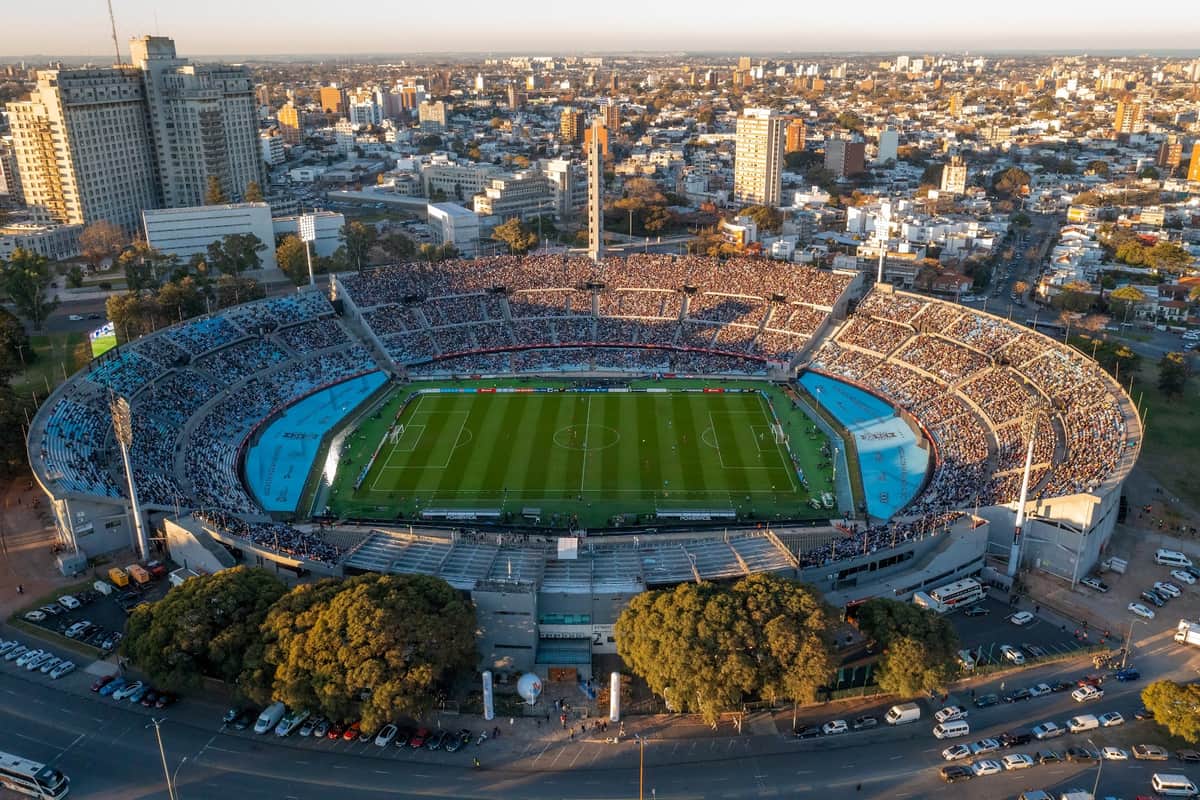
Estadio Centenario is football's original cathedral - an uncovered 1930 amphitheatre where every seat is open to the sky. The Tribuna Olímpica on the east side is the three-tier main grandstand with the best central, side-on view and the Football Museum and Torre de los Homenajes beneath it; the Tribuna América opposite (west) holds the official box, VIP palcos and press. The two ends - Colombes to the north and Amsterdam to the south - are the cheap, steep 'populares' where the loudest hinchadas gather; for a clásico the two sets of fans typically split these ends. Because the bowl is an amphitheatre, the behind-goal ends sit further back and higher, and with no roof anywhere the weather is always a factor. It hosts Uruguay internationals and the biggest Peñarol and Nacional finals and derbies, and is slated for a roof and a rise to around 63,000 ahead of a commemorative match at the 2030 World Cup centenary.
An open, Art Deco amphitheatre built in just eight months for the inaugural 1930 World Cup and named for Uruguay's independence centenary. Four separate tribunes - Olímpica, América, Colombes and Amsterdam - ring the pitch, split by open corners, crowned by the 100 m Torre de los Homenajes at one corner of the Olímpica. It has no roof over any seat and no running track, but the steep amphitheatre bowl sets the behind-goal ends noticeably back from the play. In 1983 FIFA declared it the only Historical Monument of World Football.
Seating plan & map
This is the map used for ticket sales at Estadio Centenario. Exact configuration varies by event.
How the venue is set up
Uruguay national team (La Celeste)
Full amphitheatre for internationals; the most partisan support fills the popular ends (Amsterdam and Colombes), with the Olímpica and América the calmer side stands.
Club finals & clásicos (Peñarol / Nacional)
Used as the neutral big-match venue; the two hinchadas are usually split between the Amsterdam and Colombes ends behind the goals, with the sides shared.
1930 World Cup & 2030 centenary
Site of the first World Cup final (Uruguay 4-2 Argentina, 30 July 1930). Planned renovation adds a roof over most stands - excluding the Torre de los Homenajes sector - and lifts capacity to about 63,000 for a commemorative 2030 opening match.
Concerts (occasional)
Rarely used for large concerts; an end-stage pitch layout is used, but the venue's identity and the vast majority of events are football.
Seating levels explained
Tribuna OlímpicaOlímpica - three tiers/rings, approx. 21,648
The main grandstand on the east side, rising in three tiers and holding more than a third of the crowd. The Museo del Fútbol and the Torre de los Homenajes sit beneath and beside it.
Pros: Best central, side-on view of the pitch; the largest and most complete stand; historic setting.
Cons: Completely uncovered; the upper ring is high and steep; the most sought-after (and priciest) side.
Tribuna AméricaAmérica - general seating approx. 5,957 plus VIP/press and the open Plataforma (approx. 2,911)
The west side stand facing the Olímpica, housing the official box, VIP palcos and the upper press level, with general seating in the remaining areas and an open standing platform.
Pros: Central side-on view; the premium and official side; generally quieter and more comfortable.
Cons: Smaller than the Olímpica; some areas are given over to press and officials; uncovered like the rest.
Tribuna ColombesColombes - approx. 13,914
The north end behind the goal, one of the two 'popular' terraces named for Uruguay's 1924 Olympic title in Colombes, France. Cheap, steep and loud.
Pros: Cheapest tickets; huge behind-goal atmosphere; a slice of football history.
Cons: Behind-goal angle and set well back by the amphitheatre bowl; fully exposed to sun and rain; far goal is distant.
Tribuna AmsterdamAmsterdam - approx. 13,923
The south end behind the goal, the other 'popular' terrace, named for the 1928 Olympic gold in Amsterdam. Mirror image of the Colombes and equally raucous.
Pros: Cheap and atmospheric; a favoured end for the loudest hinchada; strong behind-goal support.
Cons: Behind-goal sightline; distant from the far end of play; no cover at all from the elements.
Best seats at Estadio Centenario
Best overall view
Tribuna Olímpica, middle ring, central
The main stand's central middle tier gives the best balanced side-on view of the whole pitch from the historic Olímpica.
Best value
Tribuna Colombes or Tribuna Amsterdam (popular ends)
The cheapest seats in the ground and, behind the goals, the most atmospheric places to stand with the hinchada.
Best atmosphere
The popular end holding the home hinchada (Amsterdam or Colombes)
The behind-goal 'populares' are where the drums, flags and non-stop chanting live; for a Uruguay match or a clásico this is the loudest bank in the stadium.
Best for home attack / goals
Behind-goal at the end where the supported team attacks in the second half
Sitting in the popular end that the home or better-supported side shoots toward puts you right behind the goal celebrations.
Best side-on alternative
Tribuna América, central
A central side-on view opposite the Olímpica on the calmer VIP and press side - a good alternative if the main stand is sold out or you prefer a quieter seat.
Best for a final or neutral occasion
Tribuna Olímpica lower-central
For a neutral clásico or final, the lower-central Olímpica keeps you close to the pitch with a balanced view of both ends and both sets of fans.
| For | Sections | Why |
|---|---|---|
| Best overall view | Tribuna Olímpica, middle ring, central | The main stand's central middle tier gives the best balanced side-on view of the whole pitch from the historic Olímpica. |
| Best value | Tribuna Colombes or Tribuna Amsterdam (popular ends) | The cheapest seats in the ground and, behind the goals, the most atmospheric places to stand with the hinchada. |
| Best atmosphere | The popular end holding the home hinchada (Amsterdam or Colombes) | The behind-goal 'populares' are where the drums, flags and non-stop chanting live; for a Uruguay match or a clásico this is the loudest bank in the stadium. |
| Best for home attack / goals | Behind-goal at the end where the supported team attacks in the second half | Sitting in the popular end that the home or better-supported side shoots toward puts you right behind the goal celebrations. |
| Best side-on alternative | Tribuna América, central | A central side-on view opposite the Olímpica on the calmer VIP and press side - a good alternative if the main stand is sold out or you prefer a quieter seat. |
| Best for a final or neutral occasion | Tribuna Olímpica lower-central | For a neutral clásico or final, the lower-central Olímpica keeps you close to the pitch with a balanced view of both ends and both sets of fans. |
Seats to avoid & obstructed views
Upper Colombes and upper Amsterdam (behind-goal top rows): Set well back and high by the amphitheatre bowl, a long way from the far goal, and fully exposed to sun and rain.
Top ring of the Olímpica and América: Very high and steep with a distant view of play - the trade-off for the elevated overview.
Any seat, in bad weather: There is no roof anywhere in the current stadium, so every seat is exposed to sun, wind and rain until the planned 2030 roof is built.
Low front rows and the open corners between tribunes: The amphitheatre design sets the front rows back from the touchline for a flat, slightly distant angle, and the corner gaps give skewed views.
Accessibility & companion seating
As a protected 1930 monument the Centenario has limited modern accessibility, with wheelchair provision concentrated at ground level near the main entrances rather than throughout the tiers; the planned 2030 renovation is intended to improve access significantly. Visitors needing wheelchair or companion space should arrange it in advance through the stadium administration (CAFO) or the Uruguayan FA (AUF).
Where: Designated ground-level accessible positions near the Olímpica and América entrances at pitch level.
Book with Event Escapes
Going to Estadio Centenario? Tickets & hotels, sorted
The guide tells you where to sit — this is where you book it. Live-priced tickets and stays near the venue, all on Event Escapes.
Fixtures & tickets at Estadio Centenario
All upcoming events at Estadio Centenario
Getting there
Transport
The stadium sits in Parque Batlle, about 4.5 km east of the old city (Ciudad Vieja). It is very close to the Tres Cruces central bus terminal, a 10-15 minute walk away. From the historic centre, city buses 115 and 143 run almost directly to the ground (catch the 143 on Mercedes street, two blocks north of Avenida 18 de Julio); routes 104, 180 and 405 also stop nearby. Taxis and ride-share are widely available, and it is walkable or cyclable from the Pocitos and Tres Cruces neighbourhoods.
The area
Estadio Centenario stands in the middle of Parque Batlle, Montevideo's great green sports park, alongside an athletics track, velodrome and playing fields. Leafy residential Pocitos and the Tres Cruces transport hub are close by, with the city centre a short bus ride to the west.
Estadio Centenario · Montevideo, Uruguay
Parking near Estadio Centenario
The closest car parks to Estadio Centenario, each marked with a blue P on the map above. On event days public transport is usually quicker than driving.
- Estacionamiento11600, Unnamed Road, Avenida Italia, Montevideo428 m
- Parking av ItaliaAvenida Italia 2973, Montevideo613 m
- Parking MPDoctor Prudencio de Pena 2583, Montevideo698 m
- Parking El EscapeAvenida Italia 2589, Montevideo708 m
- Cocheras Del ParqueGerardo Grasso 2668, Montevideo731 m
- GarageDoctor José Brito Foresti 2919, Montevideo754 m
Frequently asked questions
Where are the best seats at Estadio Centenario?
The central Tribuna Olímpica - the three-tier main stand on the east side - gives the best side-on view. The middle ring balances proximity and overview; the Tribuna América opposite is the quieter alternative.
What are the cheapest seats?
The two popular ends behind the goals - Tribuna Colombes (north) and Tribuna Amsterdam (south) - are the cheapest and the most atmospheric, though they are uncovered and set back from the far goal.
Where do away or rival fans sit?
For a clásico between Peñarol and Nacional the two hinchadas are usually split between the Amsterdam and Colombes ends behind the goals, keeping the rival supports at opposite ends.
Where is the best atmosphere?
In the popular ends - Amsterdam and Colombes - behind the goals, where the drums, banners and singing of the hinchadas are concentrated.
What is the capacity of Estadio Centenario?
Around 60,235 today. A planned renovation ahead of the 2030 World Cup centenary aims to add a roof over most of the stadium and raise capacity to about 63,000.
Is Estadio Centenario covered?
No. In its current form none of the four tribunes has a roof, so every seat is open to the sun and rain. A roof over most stands (except the Torre de los Homenajes sector) is planned for the 2030 renovation.
Is Estadio Centenario accessible for wheelchair users?
Accessibility is limited by the 1930 heritage design, with ground-level wheelchair positions near the main entrances. Arrange access in advance through the stadium administration or the AUF; the 2030 renovation is intended to improve provision.
Why is the pitch so far from some seats if there is no running track?
The Centenario was designed as a football stadium with no athletics track, but its steep amphitheatre bowl and open corners set the behind-goal ends further back and higher, so the ends feel more distant than the side stands.
What is the historical significance of the stadium?
It hosted the first-ever World Cup final in 1930 (Uruguay beat Argentina 4-2) and in 1983 was named by FIFA the only Historical Monument of World Football - hence its nickname, the temple of football.
Which seats are best for concerts at Estadio Centenario?
Rarely used for large concerts; an end-stage pitch layout is used, but the venue's identity and the vast majority of events are football.
How do section numbers work at Estadio Centenario?
Section numbers at Estadio Centenario follow the seating tiers. Tribuna Olímpica: Olímpica - three tiers/rings, approx. 21,648; Tribuna América: América - general seating approx. 5,957 plus VIP/press and the open Plataforma (approx. 2,911); Tribuna Colombes: Colombes - approx. 13,914; Tribuna Amsterdam: Amsterdam - approx. 13,923.
Does Estadio Centenario have a seating map with seat numbers?
Yes. Estadio Centenario's seating map is split into numbered sections across its tiers (Tribuna Olímpica Olímpica - three tiers/rings, approx. 21,648; Tribuna América América - general seating approx. 5,957 plus VIP/press and the open Plataforma (approx. 2,911); Tribuna Colombes Colombes - approx. 13,914; Tribuna Amsterdam Amsterdam - approx. 13,923), with individual seat numbers running within each section. Check the seating map on this page or the official chart for exact seat numbers.
What is the view like from the seats at Estadio Centenario?
The best views at Estadio Centenario are from Tribuna Olímpica, middle ring, central — The main stand's central middle tier gives the best balanced side-on view of the whole pitch from the historic Olímpica. The weakest are Upper Colombes and upper Amsterdam (behind-goal top rows): Set well back and high by the amphitheatre bowl, a long way from the far goal, and fully exposed to sun and rain. For a seat-by-seat view, see the view-from-seat photos and the seating map for Estadio Centenario.
Where should I sit at Estadio Centenario with kids?
With kids at Estadio Centenario, pick aisle seats near a concourse so exits and toilet runs are easy. Note that the Tribuna Olímpica is steep, so young children and anyone uneasy with heights are better lower down.
What are the stands at Estadio Centenario?
Estadio Centenario is made up of 4 main stands: Tribuna Olímpica; Tribuna América; Tribuna Colombes; Tribuna Amsterdam.
What is the view like from the seats at Estadio Centenario?
For the best view at Estadio Centenario, aim for Tribuna Olímpica, middle ring, central (The main stand's central middle tier gives the best balanced side-on view of the whole pitch from the historic Olímpica.); Tribuna Colombes or Tribuna Amsterdam (popular ends) (The cheapest seats in the ground and, behind the goals, the most atmospheric places to stand with the hinchada.). The view is most restricted from Upper Colombes and upper Amsterdam (behind-goal top rows) (Set well back and high by the amphitheatre bowl, a long way from the far goal, and fully exposed to sun and rain.).
Where can I park at Estadio Centenario?
Car parks near Estadio Centenario include Estacionamiento, Parking av Italia, Parking MP, Parking El Escape and more. The closest is Estacionamiento, about 428 m from the venue. On event days public transport is usually quicker than driving, so check the transport options too.
More seating guides
 Photo: Jamshaid Ali / Google Maps
Allianz Arena
Munich, Germany · Football stadium
Seating guide
Allianz Parque
São Paulo, Brazil · Football stadium
Seating guide
Allianz Stadium
Turin, Italy · Football stadium
Seating guide
American Express Stadium
Brighton (Falmer), England · Football stadium
Seating guide
Anfield
Liverpool, England · Football stadium
Seating guide
BC Place
Vancouver, Canada · Football stadium
Seating guidePopular seating guides

The O2 Arena
London, England · Arena
Seating guide
Wembley Stadium
London, England · Multi-sport stadium
Seating guide
Tottenham Hotspur Stadium
London, England · Football stadium
Seating guide
Old Trafford
Manchester, England · Football stadium
Seating guide
Ibrox Stadium
Glasgow, Scotland · Football stadium
Seating guide
AO Arena
Manchester, England · Arena
Seating guideSources
- Estadio Centenario - Wikipedia
- Stadium history - Estadio Centenario (official)
- Estadio Centenario - StadiumDB.com
- Estadio Centenario: A Cathedral of Soccer Triumphs Looking Ahead to 2030 - Urban Pitch
- Estadio Centenario - World Stadium Database
Hero image: Uwebart, CC BY-SA 3.0 — via Wikimedia Commons