




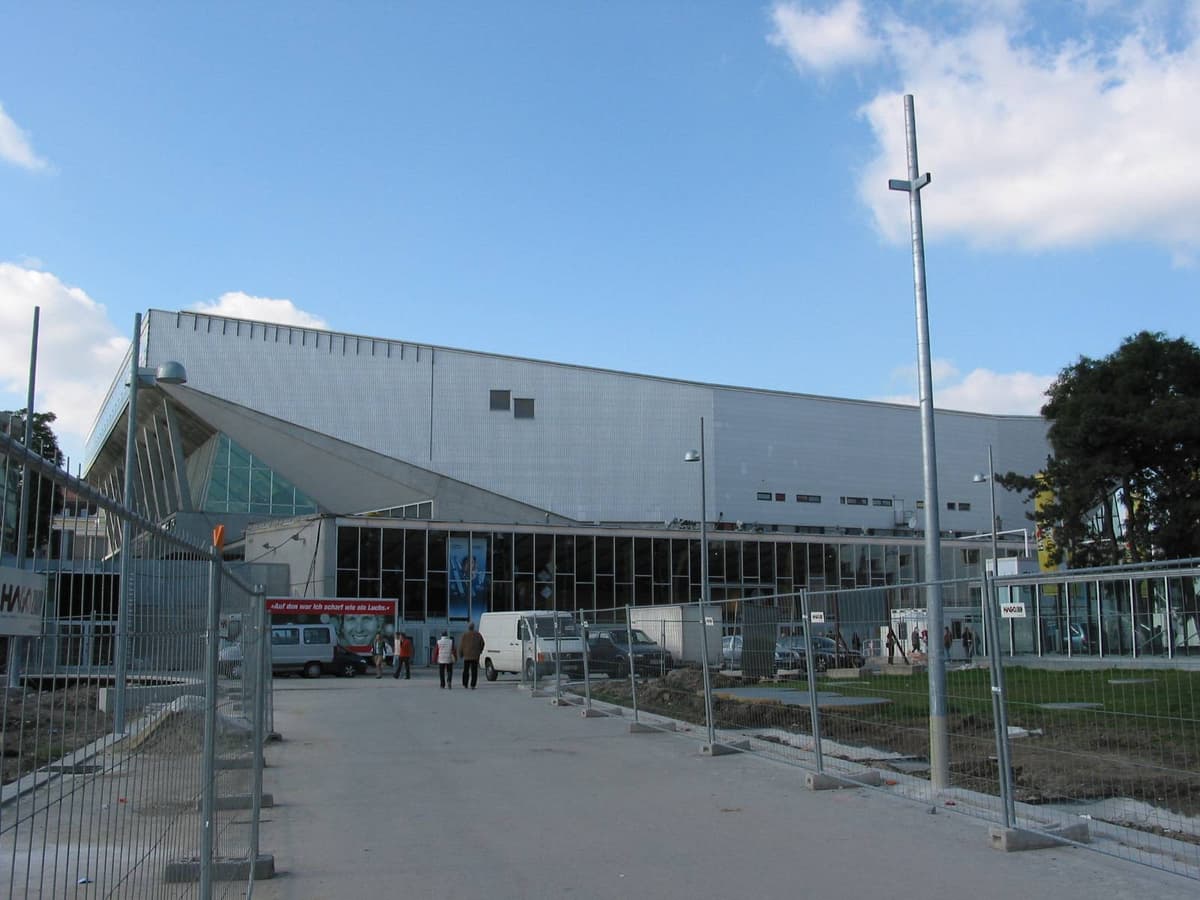
 View photos
Wiener Stadthalle Seating Map
Your seating plan and chart: where to sit, the best seats and the view from your seat
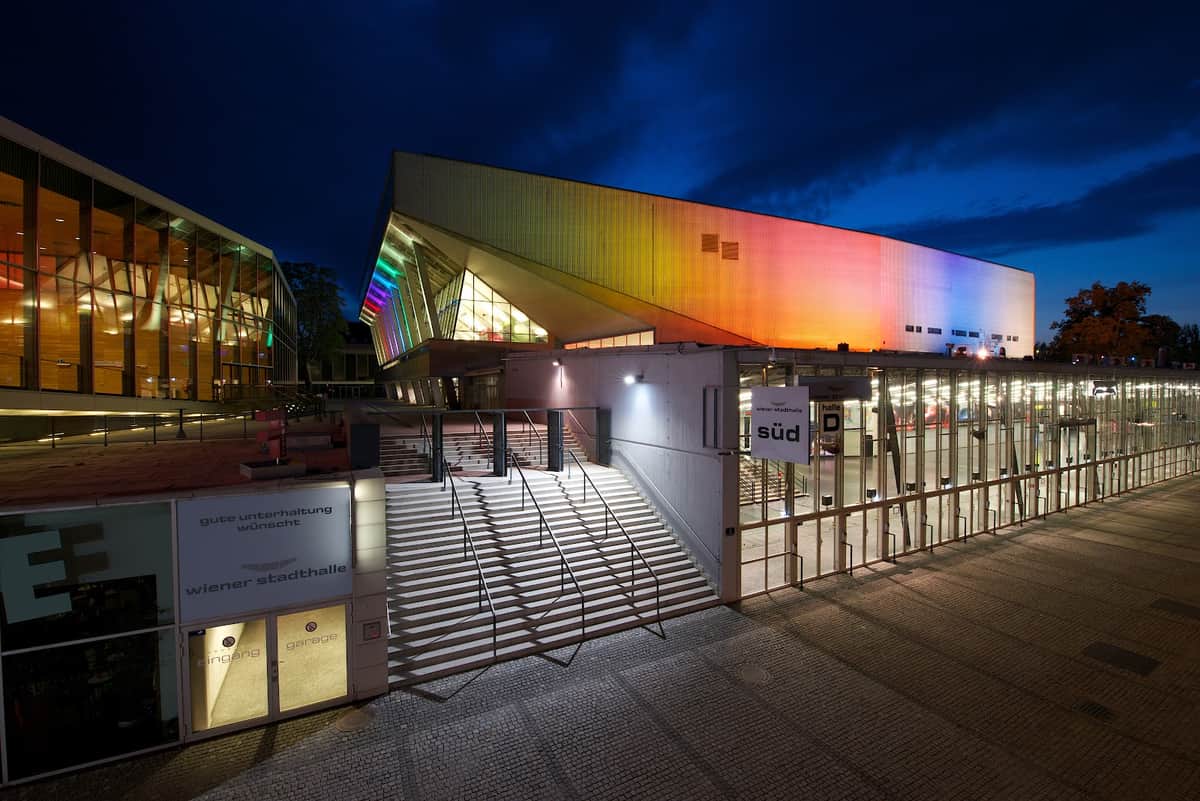
Wiener Stadthalle in photos
4 outside · 3 inside the venue
Where to sit at Wiener Stadthalle
The best seats at Wiener Stadthalle are Orchester front rows for the view. For value, choose Nordtribüne and Südtribüne, higher seat numbers. For atmosphere, head to Floor standing (Stehplatz). Avoid 1. Parkett and 2. Parkett rear rows. Wiener Stadthalle seats 16,083.
Orchester front rows
The front rows of the Orchester floor section are the nearest seats to an end stage in the fully seated concert layout.
Full detail Best valueNordtribüne and Südtribüne, higher seat numbers
The top seats of the side stands sit close to the stage and are considered a better experience than the rear floor sections at lower-tier prices.
Full detail Best atmosphereFloor standing (Stehplatz)
At standing concerts the floor holds up to 9,980 fans directly in front of the stage.
Full detail Where to avoid1. Parkett and 2. Parkett rear rows
Flat floor seating behind the Orchester section: a tall person in front can obstruct the view.
Full detailAbout Wiener Stadthalle
The Wiener Stadthalle's Hall D is Austria's largest indoor arena, holding up to 16,083 with floor standing. The hall has 10,741 seats (fixed and removable) across a flat floor — sold as Orchester, 1. Parkett and 2. Parkett at seated shows — an Osttribüne grandstand at the rear with 34 rows, raked Nordtribüne and Südtribüne ground-level stands with 15 rows on the sides, and first and second ring sections numbered in the 60s to 90s above.
The Wiener Stadthalle is a multi-purpose indoor arena and convention centre in Vienna's 15th district, designed by Austrian architect Roland Rainer; the original halls were built between 1953 and 1958 and the complex was expanded in 1974, 1994 and 2006. Hall D measures 98 by 110 metres with a 26.6-metre ridge height and can hang up to 100 tonnes of production technology from its roof, and since December 2022 around 3,000 photovoltaic panels on the roof have produced green electricity. The venue stages more than 350 events a year attracting around a million visitors.
Seating plan & map
General seating reference for Wiener Stadthalle. Check your selected event for its exact configuration.
How the venue is set up
Seated concert
The fully seated layout offers 10,741 seats, with up to 700 standing places at the second tier if required; the floor is sold as Orchester, 1. Parkett and 2. Parkett sections.
Standing concerts
The venue publishes standing versions at 3,600, 5,600, 7,600 and 10,000 floor capacity; in the largest, 9,980 stand on the floor with up to 6,103 seats remaining in the tiers. Each is also available as a 'club version'.
Sport and other layouts
The Osttribüne grandstand (2,574 seats, expandable to 4,707) faces the floor for sport such as the Erste Bank Open tennis, and curtain systems plus closable ground-level north and south stands can divide the hall; trade fairs can use up to 10,000 square metres.
Seating levels explained
Floor (Orchester, 1. Parkett, 2. Parkett)
The flat central floor. At fully seated concerts it is divided into the Orchester section nearest the stage, then 1. Parkett and 2. Parkett; rows are numbered up to about 20. At standing shows the whole floor is general admission Stehplatz, and for sport it carries the court or rink.
Pros: The front Orchester rows are the closest seats to the stage. The floor holds up to 9,980 standing fans at the biggest concerts.
Cons: The floor is flat, so a taller person in front can block the view in the Parkett sections and at standing shows.
Osttribüne
The grandstand at the rear of the hall, opposite an end stage, with 34 rows of raked seating; 2,574 seats, expandable to 4,707.
Pros: Face-on view of the whole stage, unobstructed even from the back rows thanks to the rake.
Cons: A considerable distance from the stage — facial expressions of performers will not be visible.
Nordtribüne and Südtribüne
The ground-level north and south stands, with 15 raked rows each; they can be fully closed off to divide the hall into several parts.
Pros: Raked risers give even the back rows an unrestricted view, and the higher seat numbers sit close to the stage at end-stage concerts.
Cons: A side-on angle to an end stage; sections furthest from the stage sit a long way off.
First and second ring (1. Rang, 2. Rang)Ring sections numbered 60–66, 70–76, 80–85 and 90–95
Two upper ring levels on the north and south sides, with sections numbered in the 60s to 90s; seat-view photos on A View From My Seat include sections 62 and 73.
Pros: Elevated panoramic views of the whole arena, generally at the lowest prices.
Cons: High above the floor and distant from an end stage; the second tier can hold 700 standing places at some events.
Best seats at Wiener Stadthalle
Best overall for concerts
Orchester front rows
The front rows of the Orchester floor section are the nearest seats to an end stage in the fully seated concert layout.
Best overall for sport
Nordtribüne and Südtribüne, central rows
The raked side stands look directly along the court for tennis and other court sports, with an unrestricted view even from the back rows.
Best value
Nordtribüne and Südtribüne, higher seat numbers
The top seats of the side stands sit close to the stage and are considered a better experience than the rear floor sections at lower-tier prices.
Best full-stage view
Osttribüne
The 34-row rear grandstand faces an end stage head-on with a full, unobstructed view of the entire production.
Best atmosphere
Floor standing (Stehplatz)
At standing concerts the floor holds up to 9,980 fans directly in front of the stage.
Wheelchair users
Hall D wheelchair spaces (position varies per event)
Wheelchair spaces in Hall D are positioned according to each event's hall version, with accessible toilets at foyer level and on the first tier; tickets are sold only through the Wiener Stadthalle.
| For | Sections | Why |
|---|---|---|
| Best overall for concerts | Orchester front rows | The front rows of the Orchester floor section are the nearest seats to an end stage in the fully seated concert layout. |
| Best overall for sport | Nordtribüne and Südtribüne, central rows | The raked side stands look directly along the court for tennis and other court sports, with an unrestricted view even from the back rows. |
| Best value | Nordtribüne and Südtribüne, higher seat numbers | The top seats of the side stands sit close to the stage and are considered a better experience than the rear floor sections at lower-tier prices. |
| Best full-stage view | Osttribüne | The 34-row rear grandstand faces an end stage head-on with a full, unobstructed view of the entire production. |
| Best atmosphere | Floor standing (Stehplatz) | At standing concerts the floor holds up to 9,980 fans directly in front of the stage. |
| Wheelchair users | Hall D wheelchair spaces (position varies per event) | Wheelchair spaces in Hall D are positioned according to each event's hall version, with accessible toilets at foyer level and on the first tier; tickets are sold only through the Wiener Stadthalle. |
Seats to avoid & obstructed views
1. Parkett and 2. Parkett rear rows: Flat floor seating behind the Orchester section: a tall person in front can obstruct the view.
Osttribüne back rows: A full but very distant view of the stage — performers' facial expressions are not visible from here.
2. Rang side sections at end-stage concerts: The highest seats in the house, looking steeply down at a distant stage from the side.
Floor rear at standing concerts: Far from the stage on a flat floor with crowd-dependent sightlines.
Accessibility & companion seating
The box office foyer has step-free access via automatic doors. In Hall D the positioning of wheelchair spaces varies from event to event with the hall version; wheelchair tickets are sold only directly by the Wiener Stadthalle, which also offers personal advice on +43 1 981 00-480. Barrier-free toilets are in the Hall D foyer on the north and south sides, in the rear parterre (south-west) and on the first tier (south-west); in Hall F, wheelchair spaces sit in the front half of the auditorium with companion seats directly in front in row 17 and lift access on each side. Designated disabled parking bays are at Sorbaitgasse 7 and Moeringgasse opposite number 12, and Hall F and the ticket counters have induction loops for hearing-aid users.
Where: Hall D: wheelchair spaces positioned per event configuration; Hall F: front half of the auditorium, companions in row 17
Food & drink at Wiener Stadthalle
Catering at the Wiener Stadthalle is provided by the partner Gourmet Event, with buffets serving snacks such as hot dogs and cheese sausages, sandwiches, hot drinks, cocktails, vegetarian options and smoothies, varying by event. The complex also has the Mamma Pazza restaurant at Roland-Rainer-Platz and the Wiener Stadthallen Café between Halls D and F.
Worth seeking out
- Buffets run by catering partner Gourmet Event
- Online pre-order platform for food and drinks at Hall D
- Mamma Pazza restaurant on Roland-Rainer-Platz
- Wiener Stadthallen Café between Halls D and F
Book with Event Escapes
Going to Wiener Stadthalle? Tickets & hotels, sorted
The guide tells you where to sit — this is where you book it. Live-priced tickets and stays near the venue, all on Event Escapes.
Fixtures & tickets at Wiener Stadthalle

All upcoming events at Wiener Stadthalle
Anastacia-Vienna, Austria
Mon, 12 Oct 2026 · Concerts
Vienna Open: Qualifying - Qualifications
Sat, 24 Oct 2026 · ATP Tour (250/500)
Vienna Open: Qualifying - Qualifications
Sun, 25 Oct 2026 · ATP Tour (250/500)
Vienna Open: Main Draw 1st Round - Tableau Principal 1er Tour
Mon, 26 Oct 2026 · ATP Tour (250/500)
Vienna Open: Main Draw 1st Round - Tableau Principal 1er Tour
Tue, 27 Oct 2026 · ATP Tour (250/500)
Vienna Open: Main Draw 2nd Round - Tableau Principal 2emeTour
Wed, 28 Oct 2026 · ATP Tour (250/500)
Vienna Open: Main Draw 2nd Round - Tableau Principal 2emeTour
Thu, 29 Oct 2026 · ATP Tour (250/500)
Vienna Open: Main Draw Quarter finals - Tableau Principal Quart de Finales
Fri, 30 Oct 2026 · ATP Tour (250/500)
Vienna Open: Main Draw Semi finals - Tableau Principal Demie Finales
Sat, 31 Oct 2026 · ATP Tour (250/500)
Vienna Open: Main Draw Finals - Tableau Principal Finales
Sun, 1 Nov 2026 · ATP Tour (250/500)
Andre Rieu-Vienna, Austria
Fri, 6 Nov 2026 · Concerts
Andre Rieu-Vienna, Austria
Sat, 7 Nov 2026 · Concerts
Hotels near Wiener Stadthallefrom USD 107 a night
All hotels & live prices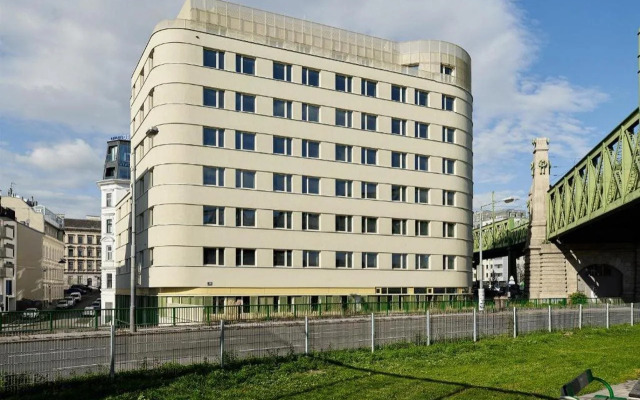 4-star
Leonardo Hotel Vienna City West
1.5 km from the venue
From USD 119 a night
See live prices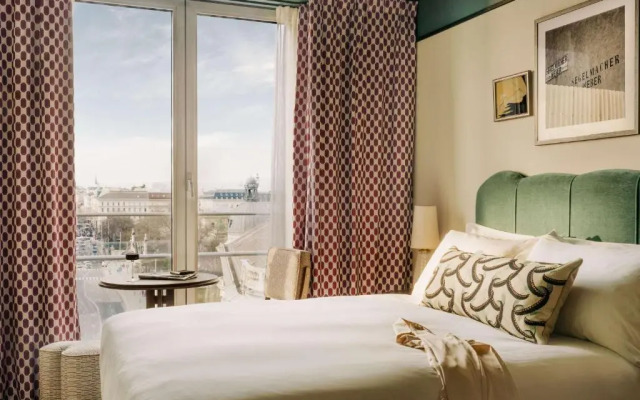 4-star
The Hoxton Vienna
3.6 km from the venue
From USD 275 a night
See live prices 3-star
Leonardo Hotel Vienna Hauptbahnhof
4 km from the venue
From USD 286 a night
See live prices 3-star
Hotel Enziana Wien
4.3 km from the venue
From USD 107 a night
See live pricesStays close to Wiener Stadthalle, with availability checked when we built this guide. Tap a hotel for live prices on your dates.
Getting there
Transport
The Stadthalle stands at Roland-Rainer-Platz 1, about five minutes from BahnhofCity Wien West and fifteen minutes from the city centre. U-Bahn line U6 stops at Burggasse-Stadthalle (three-minute walk), line U3 at Schweglerstraße (nine-minute walk), and trams 6, 9, 18 and 49 and bus 48A all serve the surrounding stops. For events whose ticket carries the 'Gilt auch als Fahrschein' imprint, the admission ticket doubles as a Wiener Linien ticket in the core zone from two hours before the event until six hours after it starts; two WIPARK garages, Märzparkgarage (750 spaces) and Stadthallengarage (up to 580 spaces), connect directly to the foyers.
The area
The venue sits in Rudolfsheim-Fünfhaus, Vienna's 15th district, immediately west of the Westbahnhof station area. The Mariahilfer Straße shopping boulevard and the Naschmarkt are a short ride away, and the city centre is around fifteen minutes by U-Bahn or tram.
Wiener Stadthalle · Vienna, Austria
Parking near Wiener Stadthalle
The closest car parks to Wiener Stadthalle, each marked with a blue P on the map above. On event days public transport is usually quicker than driving.
- RadparkplatzSorbaitgasse 7, Wien124 m
- WIPARK Märzpark ParkgarageHütteldorfer Straße 2E, Wien127 m
- Stadthallengarage - Einfahrt VogelweidplatzEinfahrt Vogelweidplatz, Moeringgasse 9, Wien198 m
- Lugner City GarageMoeringgasse 20, Wien209 m
- arte Hotel Wien StadthalleWurzbachgasse 17, Wien274 m
- Giselhergasse 1 ParkingGiselhergasse 1, Wien294 m
Frequently asked questions
What are the best seats at the Wiener Stadthalle?
At fully seated concerts the front rows of the Orchester floor section are closest to the stage. The higher seat numbers in the raked Nordtribüne and Südtribüne sit near the stage with unrestricted views, while the Osttribüne grandstand gives a full face-on view of the production from a distance.
What are the cheapest seats at the Wiener Stadthalle?
Prices are set per event by the organiser. The lowest categories are generally in the first and second ring sections (numbered in the 60s to 90s), and standing floor tickets are the budget option at standing concerts.
Is the floor seated or standing at the Wiener Stadthalle?
Both are used. At seated concerts the floor is divided into the Orchester, 1. Parkett and 2. Parkett sections; at standing shows the whole floor is general admission, with published standing versions from 3,600 up to 9,980 people. For sport the floor carries the court.
Is the Wiener Stadthalle covered?
Yes. The Wiener Stadthalle is a fully enclosed indoor arena and convention centre, and Hall D carries the largest roof for entertainment in the complex at around 10,000 square metres, so events run unaffected by the weather.
Is the Wiener Stadthalle wheelchair accessible?
Yes. There is step-free access through the box office foyer, wheelchair spaces in Hall D positioned per event and in the front half of Hall F with companion seats in row 17, barrier-free toilets at foyer level and on the first tier, and disabled parking at Sorbaitgasse 7 and Moeringgasse. Wheelchair tickets are sold only directly by the Wiener Stadthalle, which advises on +43 1 981 00-480.
How is the seating laid out at the Wiener Stadthalle?
Hall D has a flat floor (Orchester, 1. Parkett and 2. Parkett at seated shows), the 34-row Osttribüne grandstand at the rear, the 15-row raked Nordtribüne and Südtribüne on the sides, and first and second ring sections above numbered in the 60s to 90s. The hall seats 10,741 fully seated and holds up to 16,083 with floor standing.
Does the Wiener Stadthalle have hospitality or VIP tickets?
The venue's own site lists no per-event VIP ticket products; its Business Lounges are spaces rented for corporate functions, and Hall D has VIP rooms backstage for production use. Any VIP or premium packages at concerts are sold by the individual event promoters, not by the venue.
Which seats are best for concerts at Wiener Stadthalle?
The fully seated layout offers 10,741 seats, with up to 700 standing places at the second tier if required; the floor is sold as Orchester, 1. Parkett and 2. Parkett sections. For specific sections, aim for Orchester front rows — The front rows of the Orchester floor section are the nearest seats to an end stage in the fully seated concert layout.
Does Wiener Stadthalle have a seating map with seat numbers?
Yes. Wiener Stadthalle's seating map is split into numbered sections across its tiers (First and second ring (1. Rang, 2. Rang) Ring sections numbered 60–66, 70–76, 80–85 and 90–95), with individual seat numbers running within each section. Check the seating map on this page or the official chart for exact seat numbers.
What is the view like from the seats at Wiener Stadthalle?
The best views at Wiener Stadthalle are from Orchester front rows — The front rows of the Orchester floor section are the nearest seats to an end stage in the fully seated concert layout. The weakest are 1. Parkett and 2. Parkett rear rows: Flat floor seating behind the Orchester section: a tall person in front can obstruct the view. For a seat-by-seat view, see the view-from-seat photos and the seating map for Wiener Stadthalle.
How many seats does Wiener Stadthalle have?
Wiener Stadthalle holds about 16,083, though the exact number in use varies by event configuration.
What are the stands at Wiener Stadthalle?
Wiener Stadthalle is made up of 4 main stands: Floor (Orchester, 1. Parkett, 2. Parkett); Osttribüne; Nordtribüne and Südtribüne; First and second ring (1. Rang, 2. Rang).
What is the view like from the seats at Wiener Stadthalle?
For the best view at Wiener Stadthalle, aim for Orchester front rows (The front rows of the Orchester floor section are the nearest seats to an end stage in the fully seated concert layout.); Nordtribüne and Südtribüne, central rows (The raked side stands look directly along the court for tennis and other court sports, with an unrestricted view even from the back rows.). The view is most restricted from 1. Parkett and 2. Parkett rear rows (Flat floor seating behind the Orchester section: a tall person in front can obstruct the view.).
Where can I park at Wiener Stadthalle?
Car parks near Wiener Stadthalle include Radparkplatz, WIPARK Märzpark Parkgarage, Stadthallengarage - Einfahrt Vogelweidplatz, Lugner City Garage and more. The closest is Radparkplatz, about 124 m from the venue. On event days public transport is usually quicker than driving, so check the transport options too.
More seating guides
 Photo: Thomas Paar / Google Maps
Ernst-Happel-Stadion
Vienna, Austria · Football stadium
Seating guide
Avicii Arena
Stockholm, Sweden · Arena
Seating guide
MEO Arena
Lisbon, Portugal · Arena
Seating guide
Unipol Forum
Milan (Assago), Italy · Arena
Seating guide
Arena di Verona
Verona, Italy · Arena
Seating guide
Palau Sant Jordi
Barcelona, Spain · Arena
Seating guidePopular seating guides

The O2 Arena
London, England · Arena
Seating guide
Wembley Stadium
London, England · Multi-sport stadium
Seating guide
Tottenham Hotspur Stadium
London, England · Football stadium
Seating guide
Old Trafford
Manchester, England · Football stadium
Seating guide
Anfield
Liverpool, England · Football stadium
Seating guide
Ibrox Stadium
Glasgow, Scotland · Football stadium
Seating guideAlso in Vienna
More to plan and book around Vienna, all on Event Escapes.
Sources
- Wiener Stadthalle — official site (How to get there)
- Wiener Stadthalle — official Hall D rental page
- Wiener Stadthalle — Accessibility
- Wiener Stadthalle — Food & Drinks
- Wiener Stadthalle — Parking
- Wiener Stadthalle — Ticket information
- Wikipedia — Wiener Stadthalle
- A View From My Seat — Wiener Stadthalle
- Vienna tourism — Wiener Stadthalle
- MapaPlan — Wiener Stadthalle Halle D seating plan
Hero image: Extrawurst, CC BY-SA 3.0 — via Wikimedia Commons